
Switzerland’s finest pâtissiers
Chocolate, pear, and cinnamon Chantilly – or aubergine, pecan, and liquorice? Classic or avant-garde? The repertoire of Switzerland’s pâtisserie scene is more diverse and creative than ever, offering outstanding opportunities for emerging talent.

Main Image | Swiss pâtisserie is experiencing a creative renaissance. Three outstanding talents, each with their own signature style, open our new series.
Yoshiko Sato, The Japanese, Andermatt
Particularly within the world of luxury hospitality, pâtissiers find the ideal environment to develop their ideas at the highest level – working with exceptional products, an international audience, and, often, remarkable creative freedom.
In this new series, we turn our attention to those masters of their craft who set standards through skill, creativity, and a refined sense of trends. We begin with three pâtissiers whose work illustrates just how exciting and multifaceted contemporary Swiss dessert culture can be.
Yoshiko Sato is hard to impress by winter in Andermatt. She grew up in Aomori, Japan’s northernmost prefecture and one of the snowiest regions in the world. ‘When the first snow falls in autumn, it brings back a sense of home,’ she says.
However, Aomori is not only known for its heavy snowfall, but also as the centre of apple production in Japan. With cold winters and mild summers, it offers ideal growing conditions. ‘There were apple trees all around our house, and as children, we helped with the harvest.’ This early exposure sparked her fascination with apple cake. Her mother once told her that Germany made the best apple pie in the world – a thought that stayed with her.
Sato went on to study German at Toyama University, financing her education through small catering jobs. Her dream was to travel to Germany and learn how to make this celebrated dessert. Through a German acquaintance, she secured an apprenticeship in Hamburg and, at the age of 21, moved to northern Germany to train as a pastry chef at the renowned Café Schmidt. She later completed her master craftsman qualification in Cologne.


The new generation of Swiss pâtissiers masterfully combines artisanal craftsmanship with creative ideas and surprising worlds of flavour.

At some point, she heard about a German three-Michelin-starred chef who had embraced Japanese flavours and decided to apply. This led her to the restaurant of Christian Bau on the Moselle: ‘Working in a restaurant kitchen was a completely new world for me.’
At almost the same time, a young Swiss chef joined the kitchen – her future husband, Dominik Sato, who later took her surname.
After further positions with Heiko Nieder and later in Basel, the couple, together with Dominik Sato’s twin brother Fabio Toffolon, joined The Chedi Andermatt. The twins quickly became rising stars of the Swiss culinary scene, though it is less widely known that they have worked as a trio from the very beginning.
“Precision and emotion must exist in perfect balance.”
Yoshiko Sato developed a pâtisserie style deeply influenced by her Japanese heritage. ‘My wife is a Japanese precision machine,’ says Dominik Sato. ‘Incredibly fast, diligent, and exact.’
She seamlessly translates the twins’ culinary philosophy into the world of desserts. She serves genmaicha tea (green tea with roasted rice) as an ice cream, accompanied by lychee in gel and espuma form, finished with a fruity raspberry essence. Or she combines grape, jasmine, and ginger as an accompaniment to an airy silken tofu soufflé.
Once a year, she returns to Japan with her husband and their two children: ‘For me, it is not just a holiday, it is also a paradise for sourcing products.’
Originally from Buenos Aires, Damián Carini is the executive pastry chef at the Bürgenstock Resort Lake Lucerne, overseeing all the property’s culinary outlets.

Damián Carini, Bürgenstock Resort Lake Lucerne
When Damián Carini left his hometown of Buenos Aires at the age of 21, he was convinced he would return within three months. His plan was simply to complete an internship at what was then considered the world’s most celebrated restaurant, El Bulli near Barcelona.
However, when the three months came to an end, Ferran Adrià offered him a permanent position – and what young pâtissier would have declined? Carini was captivated by the boundless creativity and the groundbreaking culinary techniques he encountered there. ‘The level was incredibly high. We had 50 chefs in the kitchen for just 45 guests.’
Carini, who has been the executive pastry chef at the Bürgenstock Resort Lake Lucerne since its opening, continues to draw on these formative experiences. From Catalonia, he moved to Marseille, to the three-Michelin-starred Le Petit Nice Passédat – the complete opposite of El Bulli. There, he mastered the fundamentals of French classicism: ‘Technique, temperature, precision.’ He was equally impressed by the French work ethic: ‘There was an almost military discipline in the kitchen, but also great respect.’
“We play with flavour, but always for the guest.”
Carini arrived in Switzerland in 2007 and has remained ever since. From Lausanne Palace to The Alpina Gstaad, he worked exclusively in leading establishments until 2017, when Mike Wehrle, corporate culinary director at the Bürgenstock Resort, invited him to join. Wehrle holds his executive pâtissier in the highest regard: ‘He can do everything. His repertoire is vast.’
Ranging from classic millefeuille to deconstructed tiramisu and even spectacular creations such as a giant decorated Easter egg for the lobby, Carini describes his style as ‘very light, with little sugar, but all the more imagination.’
For each of the resort’s restaurants, he has developed a distinct dessert concept. ‘At Spices Kitchen & Terrace, we play with Asian flavours, adapted to the European palate.’ A prime example is his signature dessert ‘Above the Clouds’: mango and passion fruit sorbet, coconut espuma, yuzu gel, and banana compote, served in a coconut shell and decorated with orchids.
A similarly striking effect – albeit in a completely different style – can be experienced at the newly conceived Verbena by Christian Scharrer in the Waldhotel by Bürgenstock. His reinterpretation of the Black Forest gâteau is exceptional: a visually refined dessert featuring cherry sorbet and morello cherries soaked in kirsch (cherry brandy), encased in dark chocolate – a contemporary homage to Scharrer’s Black Forest heritage.

André Siedl, Widder Restaurant, Zurich
When Felchlin releases a new selection, André Siedl’s phone rings. The pâtissier at Widder Restaurant in Zurich has enjoyed a long-standing collaboration with the premium chocolate manufacturer. This is why he receives allocations of rare varieties such as Trinidad Tortuga: ‘Only one tonne is produced – that is almost nothing.’
This chocolate, with its high cocoa content (72%) and low acidity, comes from a small family farm on the island of Trinidad, and supply is extremely limited. In Siedl’s hands, it is transformed into ganache and brownie, paired with blackcurrants that he preserves each summer for the winter months. It is served with hazelnut ice cream, homemade advocaat sauce, and topped with blackcurrant granité, refined with cassis vinegar. The result is a complex dessert of remarkable depth.
It is precisely the kind of dessert that defines the work of Stefan Heilemann’s preferred pâtissier. The two have collaborated for more than 10 years. The two-Michelin-starred chef (18 GaultMillau points) trusts Siedl implicitly, knowing he can rely on his composure even during the busiest services.
In such moments, Siedl benefits from his solid classical training: ‘It was a very traditional establishment where everything was made by hand. Nothing ever came from a packet.’ As a result, every movement is second nature to him – a skill further refined during his time at Hotel Bareiss in the Black Forest, a renowned training ground for hospitality professionals: ‘Every evening, we sent out countless plates – it was training for life.’
Siedl regrets that pâtisserie is sometimes driven too strongly by fleeting social media trends, such as the overuse of identical moulds that make desserts interchangeable. Instead, he focuses on what truly matters: ‘What does it take to make guests happy?’
He typically serves two desserts with contrasting flavour profiles. Before presenting the chocolate and cassis creation, he might offer an elegant variation of tarte Tatin: layered and caramelised Boskoop apple, crisp puff pastry, sour cream and sour cream ice cream. Visually, the dessert is deliberately clean. As Siedl puts it: ‘What is there, must make an impact.’
André Siedl’s philosophy is to make guests happy – beyond short-lived social media trends and through thoughtfully minimalist plating.


Words Patricia Bröhm
-
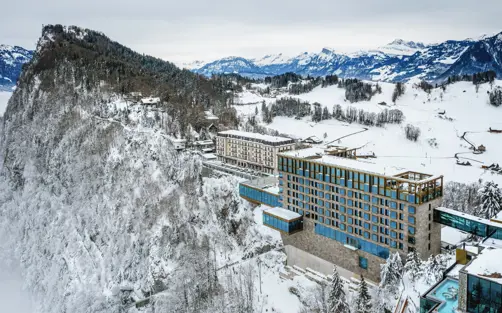
60ha resort, 2 luxury hotels, 1 chalet hotel, residences, unparalleled views
Bürgenstock Resort Lake Lucerne
Bürgenstock60ha resort, 2 luxury hotels, 1 chalet hotel, residences, unparalleled views
-
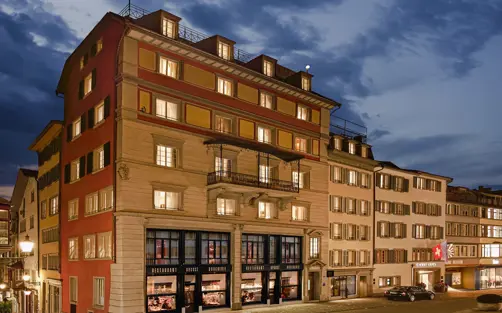
Unrivaled synthesis of arts, elegance & culinary delights
Widder Hotel
ZurichUnrivaled synthesis of arts, elegance & culinary delights
-
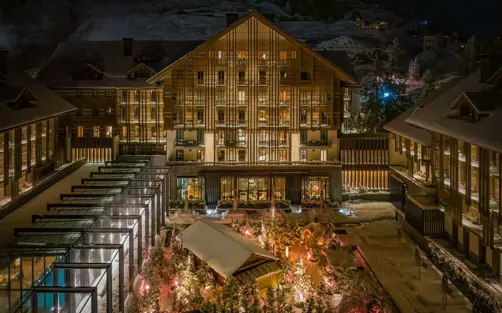
A perfect location featuring alpine chic paired with asian style.
The Chedi Andermatt
AndermattA perfect location featuring alpine chic paired with asian style.


Related Stories

The world of natural and orange wines is remarkably diverse. From flawed to exceptional examples, almost everything can be found on the market. Here is a selection of five bottles that are well worth exploring.
Discover more
This fruit is a knockout! Insalata di cedro instantly whisks you away to the Amalfi Coast. Along the winding coastal road, vendors display towering piles of aromatic fruits, while on the steep terraces, trees glow with golden cedri.
Discover more
Whether you are drawn to familiar comforts or curious new discoveries, our gourmet edit invites you to savour summer with imagination.
Discover more
No question about it: the elegant Mandarin Oriental Palace, housed in a stately 1906 Belle Époque ensemble directly on the promenade of Lake Lucerne, ranks not only among Switzerland’s most prestigious hotel addresses, but is also a compelling destination for discerning gourmets seeking the ultimate culinary delights.
Discover more
Natural and orange wines are gaining attention and increasingly appearing on shelves as well as hotel and restaurant wine lists. Simultaneously fascinating and occasionally difficult to interpret, they can be polarising. Here, we take a closer look.
Discover more
Behind every plate at La Réserve Eden au Lac Zürich lies a story: tomato fields at dawn, olive groves in the heat of summer, pasta machines from the 1970s and, above all, people who work with devotion. Together with chef Marco Ortolani, we visit two producers without whom his cuisine would not be the same.
Discover more
A good wine deserves the right glass. When choosing glassware, it pays to rely on established producers – those with a legacy of expertise and innovation. Whether you opt for machine-made or handcrafted models depends on your budget and how and where the glass will be used.
Discover more