
The Most Coveted Seats in Switzerland
The story of the Glacier Express dates back to the golden 1920s, when affluent tourists from around the globe began discovering the magic of the Swiss mountains.

Not long after its maiden voyage on June 5, 1930, the Glacier Express was already being mentioned in the same breath as the other legendary trains of that era. A ride aboard the ‘slowest express train in the world’ became a the other legendary experience on a Grand Tour de Suisse. Today, around 250,000 passengers a year use the Glacier Express as an exclusive gateway to the stunning natural wonders of the High Alps.
Back then, the journey from the remote Valais mountain village of Zermatt, at the foot of the Matterhorn, to the picturesque Upper Engadin town of St. Moritz took nearly 11 hours. Except for the short section between Brig and Disentis, the route was electric from the start – an impressive engineering feat given the challenges. For decades, the indestructible Swiss Crocodiles of class 6 led the train. As the Märklin catalogue once put it, they ‘slithered through tight switchbacks and bent like reptiles’. Even 95 years later, the 291-kilometre route – with its 91 tunnels and 291 dizzying bridges and viaducts – has lost none of its appeal. The train’s name harks back to its original route, which, until the opening of the Furka Base Tunnel, ran along the mighty Rhone Glacier.
In 2019, the RhB (Rhaetian Railway) and the Matterhorn Gotthard Bahn – joint operators of the Glacier Express – introduced one of the most exclusive rail travel experiences in Europe: Excellence Class. Once a day in each direction, a dedicated carriage runs between Zermatt and St. Moritz. Only 20 passengers at a time enjoy this transalpine journey, passing deep blue lakes, roaring gorges, charming alpine villages, historic towns and majestic peaks – complete with gourmet meals. Even today, the trip takes nearly eight hours.
The crossing of the historic Landwasser Viaduct is one of the most spectacular highlights during our train ride.

Our journey begins at the St. Moritz train station. Glacier Express No. 903, marked with a distinctive golden diagonal stripe, departs daily at 8:39 a.m. and arrives in Zermatt 8 hours and 28 minutes later. The return trip, No. 902, departs Zermatt at 8:52 a.m. and reaches St. Moritz at 4:37 p.m. With an average speed of just 42 km/h, the Glacier Express truly takes its time – which is a good thing, as Valais and Engadin show off their finest sides throughout the journey. The scenery evokes a supersized model train landscape. Many of those willing to pay the CHF 792 Excellence Class fare also stay a few nights before or after the trip at one of the iconic hotels that have adorned glamorous Zermatt and St. Moritz for over a century. Names like Badrutt’s Palace, Suvretta House, Grand Hotel Zermatterhof and Mont Cervin Palace sound like music to the ears of luxury-minded train enthusiasts. In fact, it’s hard to find a five-star hotel in either town that doesn’t offer Glacier Express packages.
On the eve of our journey, we dine opulently at the Grand Restaurant of Suvretta House (opened in 1912), which feels like stepping into a time machine. We then sink into the down-filled pillows of our king-size bed. The next morning, Excellence Class guests are greeted on the platform by a separate check-in desk and a red carpet, where concierge Joaquim welcomes us warmly. After all, there has to be a difference between Excellence and regular First Class – let alone Second Class.
Until the 1980s, the Glacier Express only operated during the summer (June to October), as the Furka Pass was impassable in winter due to snow walls up to 20 metres high. But since the Furka Base Tunnel opened, special trains now run the route year-round, with only a short pause between mid-October and mid-December. Travellers can choose between springtime alpine vibes, lush green summer meadows, golden autumn days, or deep, snow-covered winter wonderlands. The best times to travel are from early July to mid-September and mid-December to the end of March – unless you’re specifically seeking solitude.
Passengers in the 1930s could only dream of the luxury that Excellence Class delivers today.

We leave the red carpet behind and settle into the outrageously comfortable, electrically adjustable armchairs – better than many business-class airline seats and arranged in a single row so everyone has a guaranteed window view. Joaquim stores our luggage while the bar at the end of the Excellence carriage beckons with stylish apéritifs and afternoon cocktails. An oversized golden compass mounted on the ceiling helps guests orient themselves amid the countless switchbacks and tunnels. Alongside our real-life concierge, every guest also receives an iPad packed with info about the route, the region and its people. Naturally, there’s onboard WiFi too – but with the picture perfect scenery gliding past outside, who could stare at a screen? No sooner has the Glacier Express left St. Moritz on the dot than it makes a sharp right at Bever and heads straight into the six-kilometre Albula Tunnel. This marks the start of the 62-kilometre Albula Line, a UNESCO World Heritage Site since 2008 and the first highlight of the journey. The train descends over 1,000 metres in altitude and crosses the world-famous Landwasser Viaduct. Built in 1903, it is a 65-metre tall feat of engineering that symbolises the Rhaetian Railway’s pioneering spirit and is, alongside the Matterhorn, an icon of Excellence Class.
Time for the first round of refreshments: a chilled glass of Laurent-Perrier Champagne, served with delicate beef tartare tartlets and classic Swiss Chäschüechli (cheese pastries). So far, excellent. We’re now about 30 minutes from Chur, the proud episcopal seat and oldest city in Switzerland. After a brief stop, we continue through the romantic Rhine Gorge toward the Oberalp Pass – at 2,033 metres above sea level, the point of our journey and one of the most beautiful. As turquoise whitewater roars far below and massive cliffs tower above, we’re served a pea and mint soup topped with dried alpine flowers and a cheeky dollop of cream, which teeters on the plate as the train curves sharply. But not to worry – everything here is balance with Swiss precision, including the alpine-grade porcelain. We reach Disentis, home to a majestic Benedictine monastery, at around 12:30 p.m. Here, both the train engine and operator switch from the Rhaetian to the Matterhorn Gotthard Bahn. Shortly after Disentis, in the alpine wilderness near Mompeé, we pass our counterpart train, No. 902.
Images | Glacier Express AG – Stefan Schlumpf

As the Glacier Express climbs ever steeper terrain with the help of cogwheels, the main course is served: a melt-in-your-mouth Swiss beef filet with truffled potato mousseline and braised leeks, paired with an excellent red cuvée from Valais. It’s the finest dining we’ve ever experienced on a train. After the pass summit – just a few kilometres from the Rhine’s source – we cross beneath avalanche shelters into the canton of Uri. We descend into the ski resort of Andermatt and soon plunge into the 15-kilometre Furka Base Tunnel connecting Uri with Valais. As we glide beneath the towering Furka massif, dessert is served: a warm Gâteau au Chocolat with vanilla sauce and roasted almonds, accompanied by a luscious dessert wine. A nap would be ideal now, but there’s still the Rhone Valley to cross and the final 26-kilometre climb through the Mattertal to Zermatt, where the Glacier Express tackles gradients of up to 12.5% before finally pulling into its terminus beneath the mighty peak of the Matterhorn.
On the platform, a liveried coachman from Mont Cervin Palace awaits us with an open carriage drawn by two magnificent black horses, ready to transport us through the pedestrian zone to the 1851 grand hotel, where every room boasts a spectacular Matterhorn view. Just 150 metres away, the Grand Hotel Zermatterhof – another historic five-star property – welcomes guests with equal flair, offering carriage transfers with two striking white horses instead.
If you still haven’t had your fill of rails, ride the next day on the Gornergrat Railway – the highest open-air cogwheel train in Europe – which climbs to 3,089 metres. From here, you can enjoy one of the most breathtaking, easily accessible panoramas in the Alps: not just the Matterhorn, but also 29 peaks over 4,000 metres forming a towering alpine amphitheatre. Want to go even higher? Hop on the 3S cable car to the Matterhorn Glacier Paradise at 3,883 metres. Some gondolas have glass floors offering dizzying views of glaciers 200 metres below – not for the faint-hearted. Bon voyage!
Towering over Zermatt at 4,478 metres, the Matterhorn stands as one of Switzerland’s most legendary landmarks. As the Glacier Express winds its way through the Alps, passengers are treated to breathtaking views of this majestic giant as an unforgettable highlight along the world’s slowest express train journey.

Hotel Tips – St. Moritz
Badrutt’s Palace The motto of this legendary icon in central St. Moritz: ‘See and be seen’.
badruttspalace.com
Suvretta House An alpine hideaway with rich traditions and panoramic views – ideal
for well-heeled guests seeking discretion.
suvrettahouse.ch
Carlton Hotel St. Moritz Exclusive all-suite hideaway with panoramic views and award-winning fine dining. tschuggencollection.ch
Kulm Hotel St. Moritz Considered the cradle of winter tourism, this hotel has been combining luxurious hospitality with magnificent views of Lake St. Moritz since 1856. kulm.com
Hotel Tips – Zermatt
Mont Cervin Palace A historic luxury hotel housing some of Zermatt’s best restaurants. Stunning Matterhorn views included. montcervinpalace.ch
Grand Hotel Zermatterhof Situated in Zermatt’s most beautiful square, offering true grand hotel ambiance at the edge of the world. zermatterhof.ch
Riffelalp Resort At 2,222 metres above Zermatt, this Alpine Luxury Resort offers complete seclusion and an incomparable view of the Matterhorn. riffelalp.com
Travel Info
The Glacier Express operates year-round, except for a short break from mid-October to mid-December. Tickets from St. Moritz to Zermatt or vice versa cost CHF 159 (2nd class) and CHF 272 (1st class), plus a mandatory seat reservation fee (CHF 49).
Excellence Class requires a 1st class ticket and carries a surcharge of CHF 490. Partial routes with reduced reservation fees are available. Holders of the Half-Fare Card receive 50% off the fare; Swiss Travel Pass holders pay only the reservation fee.
Words Thomas Hauer
-
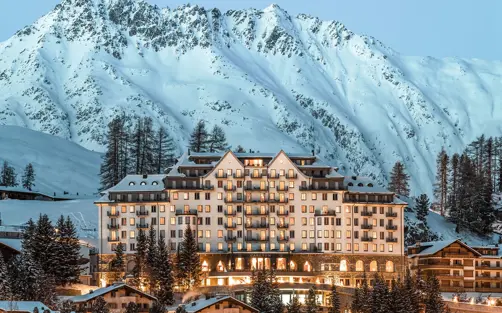
Most intimate hotel, though having the largest penthouse suite
Carlton Hotel St. Moritz
St. MoritzMost intimate hotel, though having the largest penthouse suite
-
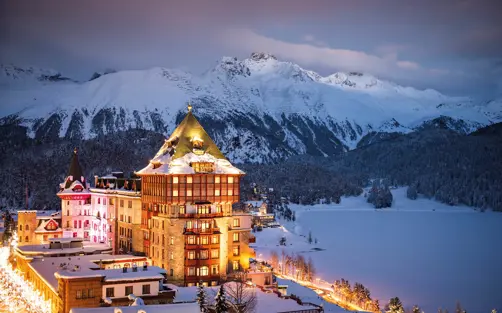
Landmark Alpine hotel blending historic charm and world-class service
Badrutt's Palace Hotel
St. MoritzLandmark Alpine hotel blending historic charm and world-class service
-
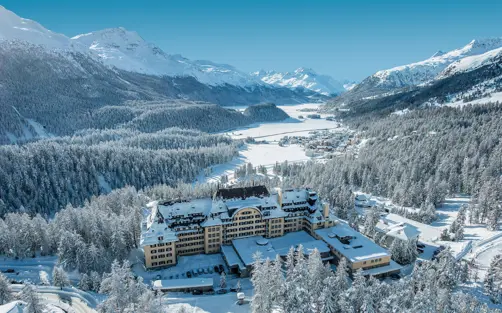
The pinnacle of quality, style & cordiality in St. Moritz
Suvretta House
St. MoritzThe pinnacle of quality, style & cordiality in St. Moritz


Related Stories

I have had a new tax advisor since last year. His name is Sepp, and he was a serendipitous find. Meeting him electrified me. Not because he charges about a tenth of what I used to pay for having my tax return completed, but because he is someone who has found his calling: he loves what he does. And it is exactly what gets him out of bed in the morning.
Discover more
The rules of luxury are being rewritten. Not quietly, in boardrooms, but out in the open – on stages, in workshops, and in the kind of honest conversations that rarely happen at formal conferences. TheNewNow Future Summit brought some 350 leaders and innovators together at the Headsquarter in Zurich for exactly that: a day designed not to deliver answers, but to ask better questions.
Discover more
A family legacy, a decade of creation, and a new chapter where fashion meets haute perfumery.
Discover more
Staying in a suite always feels a little like moving into a brand-new home. Small, yes. Temporary, yes. But entirely yours. And best of all, without the planning or the headaches over big questions and tiny details. No delays, no years of waiting. Someone has already arranged everything, planned it all, and executed it to perfection.
Discover more
Spending a summer weekend on the shores of Lake Lucerne is always a good idea. And if you get to check in at the Park Hotel Vitznau, you’re pretty much guaranteed an unforgettable experience. Grab your most glamorous sunglasses and join me!
Discover more
The first time I really noticed, it must have been around 2022. It was during one of the first post-pandemic years, when many of us had been forced – often for the very first time – to ease up on the gas pedal we’d been flooring for decades.
Discover more
There are mornings in Zurich when the lake feels like a mirror held up to the sky, silver grey and perfectly still. The kind of morning that urges you to slow down and look around, to enjoy. And on the second floor of one of the city’s most quietly spectacular hotels, the guests of La Réserve Eden au Lac Zurich will find a new reason to do exactly that.
Discover more